Your check engine light is on with a lean code like P0171, the engine idles rough or you hear a whistle under the hood. The shop thinks it is a vacuum leak, and the fix can be a cheap tube or a gasket that takes hours.
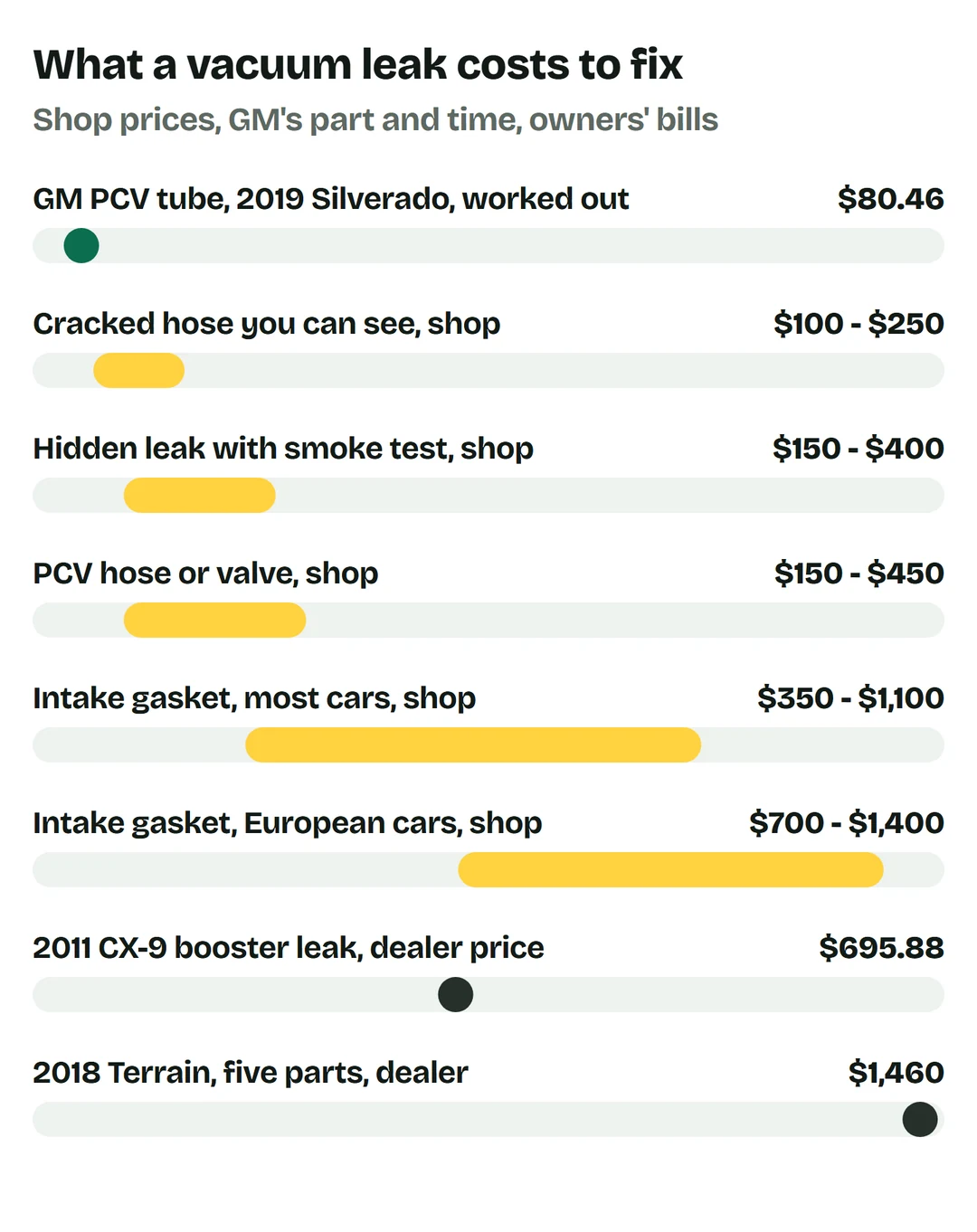
So how much does vacuum leak repair cost? At Irish Mike’s, a repair shop in Orlando, a cracked vacuum hose you can see is $100 to $250, and $150 to $400 when the leak takes a smoke test to find.
A leaking intake manifold gasket costs more: $350 to $1,100 on most cars at Luxury Auto Works, a shop in Austin, and $700 to $1,400 on European ones.
With GM’s own part and job time, a leaking PCV tube on a 2019 Silverado 5.3 comes to $80.46.
In this guide I will show you what shops charge for each kind of leak, what GM’s part and time come to and what owners paid. Then why the leak should be found before parts are bought, and the signs to look for.
What Repair Shops Charge for a Vacuum Leak
A vacuum leak is outside air getting into the engine behind the air sensor, through a cracked hose, a gasket or a valve. What it costs depends on which part leaks and how hard it is to reach. Irish Mike’s prices, from January 2026:
Luxury Auto Works in Austin has the same kind of spread for the bigger jobs. An intake manifold gasket is about $350 to $650 on a four cylinder, $600 to $1,100 on a V6 or V8, and $700 to $1,400 on BMW, Mercedes, Audi and similar cars.
A plain PCV valve with outside hoses is $150 to $450 there, 0.5 to 1.5 hours. On many European engines the PCV valve sits in the valve cover or a separator, and that job is $450 to $1,100 or more, 2 to 4 hours.
What GM’s Part and Time Come To
GM found that the PCV tube on 2019 and 2020 Silverado and Sierra 1500 trucks with the 5.3 V8 can be put in wrong, damaged or not pushed fully home. That lets air into the engine, sets codes P0171 or P0174 and can make a whistling noise.
The dealer checks the tube and smoke tests it, reseats it if it is only loose, and fits a new one if it is cracked. GM pays 0.5 hour for the test and repair.
With GM’s part on a dealer parts website, checked October 13, 2026, and $132 an hour, Tekmetric’s US average from June 2026:
So a leaking PCV tube on these trucks comes to $80.46. Many vacuum leaks are this cheap once someone finds them, which is why the finding matters more than the part.
What Owners Paid
Here is what owners told NHTSA they paid or were quoted, with a link to each complaint:
- A Ford dealer found the hard brake pedal on a 2013 Escape came from the vacuum line, “a $300+ service”, filed in December 2019.
- A Mazda dealer priced the repair of a vacuum leak at the brake booster of a 2011 CX-9, which hissed and felt mushy, at $695.88, $130 of it for the part, filed in August 2013.
- A GMC dealer fixed a 2018 Terrain that stalled on the highway by replacing five parts, among them the PCV tube, an oxygen sensor and the air inlet tube, for $1,460, filed in December 2023.
- The owner of a 2014 Malibu with a P0171 code spent over $1,000 on a PCV valve, air flow sensor and oxygen sensor before the shop found loose intake bolts, filed in April 2024.
So owners paid or were quoted $300 to $1,460, and the Malibu owner paid for parts that were not the problem.
Find the Leak Before Buying Parts
A lean code tells you air is getting in, not where. Before you pay for sensors, ask the shop for a smoke test. The machine fills the intake with harmless smoke, and the smoke comes out wherever the leak is.
GM’s own bulletins on lean codes and air leaks ask the dealer for smoke test results and pictures of the leak. If a shop wants to replace a sensor for a P0171 code without one, ask why.
A PCV Valve Is a Small Part With a Big Job Behind It
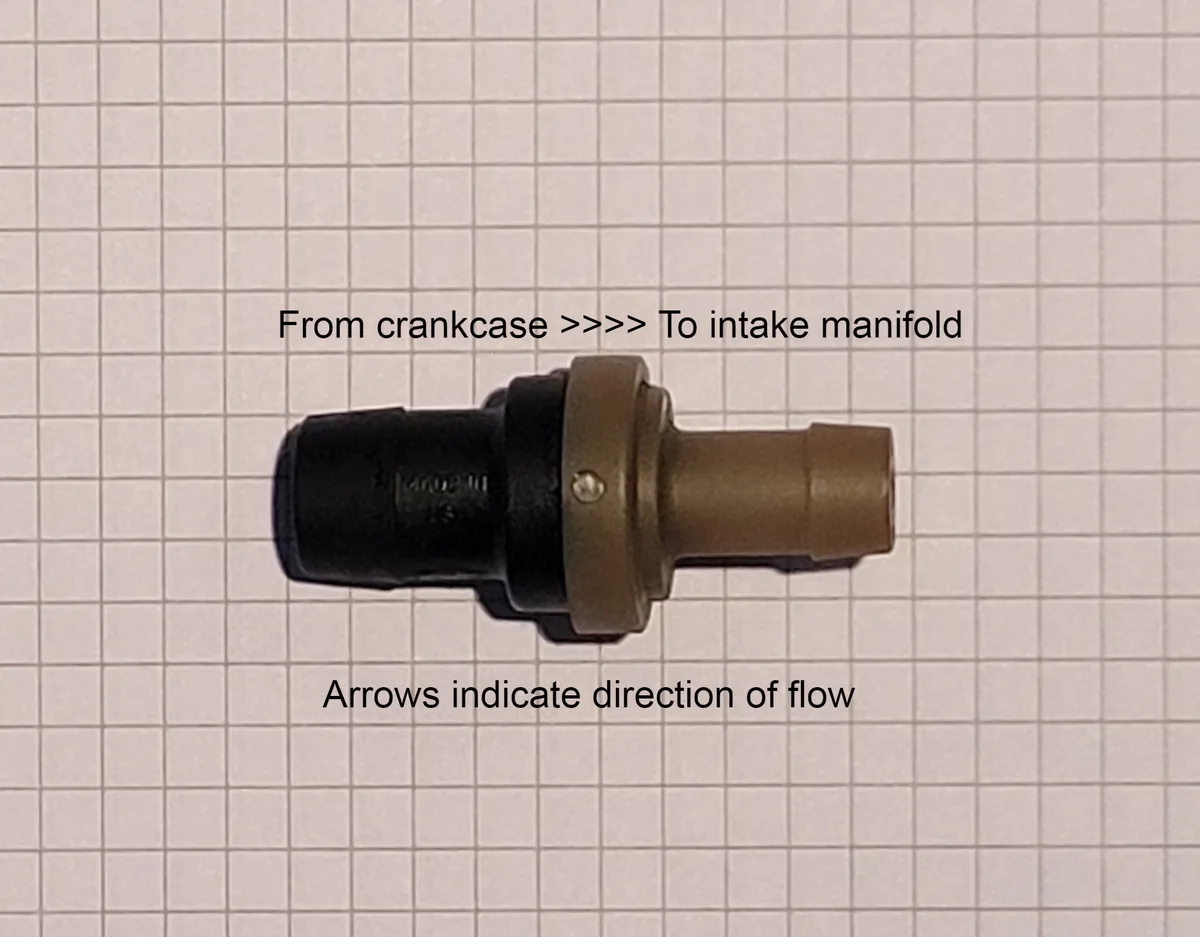
The PCV valve lets gases from the crankcase into the intake. When it cracks it is a vacuum leak, and when it sticks shut the pressure has to go somewhere else.
On a 2017 Chevrolet Equinox, a failing PCV system made the rear main seal fail. Fixing the PCV meant taking off the intake and valve cover, and the shop put the job at 13 hours, about $2,500, filed in February 2024.
Why You Should Not Wait
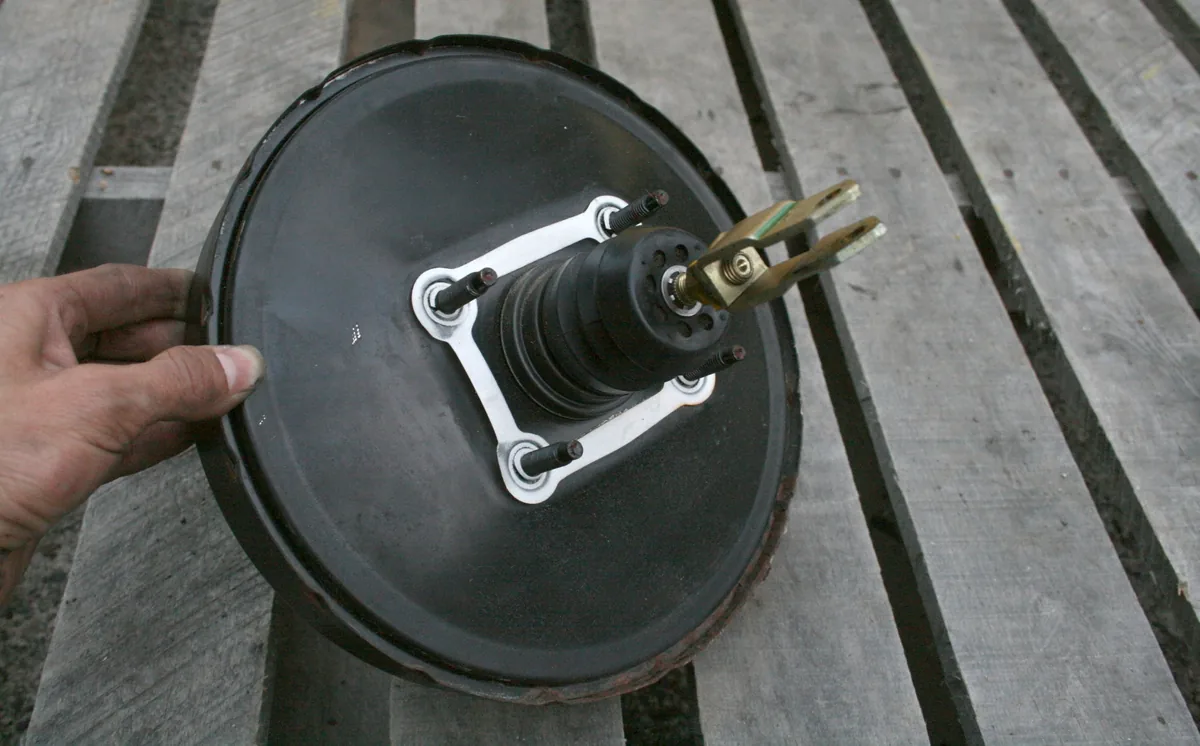
The power brakes run on engine vacuum too. A leak in the brake booster or its hose makes the pedal hard to push, as the Escape owner above found, and it takes more effort to stop.
Carmakers have recalled cars for it. Ford recalled 605,684 2005 and 2006 F-150 and Mark LT trucks with the 5.4 V8 because the booster’s vacuum hose could swell and come off. Dealers replaced the hose.
An engine leak is less urgent, but the check engine light stays on and the engine keeps running lean until it is fixed.
How to Tell You Have a Vacuum Leak
These are the signs GM’s customers report: the check engine light, a rough idle, running lean and a whistle type noise. Codes P0171 and P0174 often come with them.
A hissing sound with the engine running and a hard or mushy brake pedal are also worth a look. With the engine off, check the rubber hoses on top of the engine for cracks and loose ends.
Answers to Vacuum Leak Questions
How much does it cost to fix a vacuum leak?
A shop in Orlando prices a cracked hose you can see at $100 to $250 and a hidden leak with a smoke test at $150 to $400. An intake manifold gasket is $350 to $1,100 on most cars at a shop in Austin.
How much is a smoke test for a vacuum leak?
Irish Mike’s in Orlando prices a smoke test with the repair at $150 to $400 when the leak cannot be seen.
Can I drive with a vacuum leak?
A small engine leak can wait a few days, but a leak at the brake booster cannot. If the brake pedal turns hard, have it fixed before you drive far.
Will a vacuum leak cause a P0171 code?
It can. GM’s bulletins on PCV tube leaks list P0171 and P0174 with a rough idle and a whistle noise.
How long does it take to fix a vacuum leak?
GM pays 0.5 hour to test and fix a PCV tube leak. An Austin shop counts 0.5 to 1.5 hours for a plain PCV valve and 2 to 4 hours when it sits in the valve cover.
Where These Prices Come From
- Irish Mike’s Automotive, Vacuum Leak Repair Cost, Orlando, Florida, January 28, 2026. Luxury Auto Works, Intake Manifold Gasket Replacement and PCV Valve Replacement, Austin, Texas, February 2026.
- GM bulletin PIP5686A (November 2019) and PIE0501 (February 2019), and Ford recall 08V208, on NHTSA’s website.
- Part price, checked October 13, 2026: GMPartsGiant 12729666. Tekmetric, Average Auto Repair Labor Rates by State, June 30, 2026, and the owner complaints to NHTSA linked above, read October 13, 2026.
I hope this helps you find the leak before you pay for parts you do not need. If you have any questions, you can email me at costcheckr@gmail.com.