


A solar proposal promises a smaller electric bill, but the first page can hide the number you need most: what you will actually pay to have the system installed.
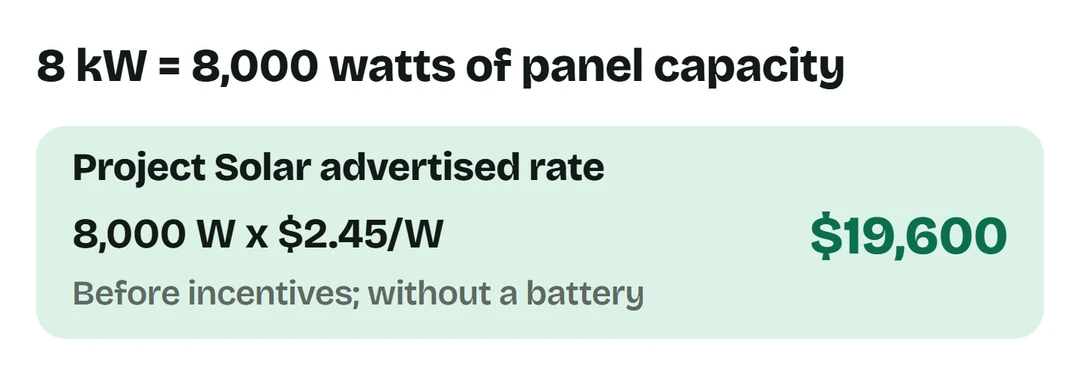
At Project Solar’s advertised rate of about $2.45 per watt installed, a 6 to 8 kW system works out to about $14,700 to $19,600, before incentives and without a battery.
These are worked examples from an installer’s advertised rate, not a national price range. I will show the sums, compare owners’ proposals, and explain the roof work, storage and payment terms that can change your bill.
Do Not Subtract the Old Federal Credit
For a new installation in 2026, this needs checking before any price comparison. The IRS Residential Clean Energy Credit page states that the credit is unavailable for property placed in service after December 31, 2025.
That means the former 30% homeowner credit should not be deducted from a new 2026 system in your budget. A proposal displaying an old after-credit price can make the amount you must pay look much smaller.
State, utility and local programs have their own rules. Ask for each named program and its eligibility requirements, rather than accepting one unexplained “incentives” total.
Solar Installation Prices by System Size
Project Solar’s media page advertises about $2.45 per watt fully installed before incentives.
One kilowatt is 1,000 watts. Multiply the system’s panel capacity in watts by the installed rate. Here are my sums using that advertised rate:
Project Solar’s figure is an advertised approximate rate, not a quote for your address. Its media page is undated, so ask the installer for a current proposal.
What Does the Installation Price Buy?
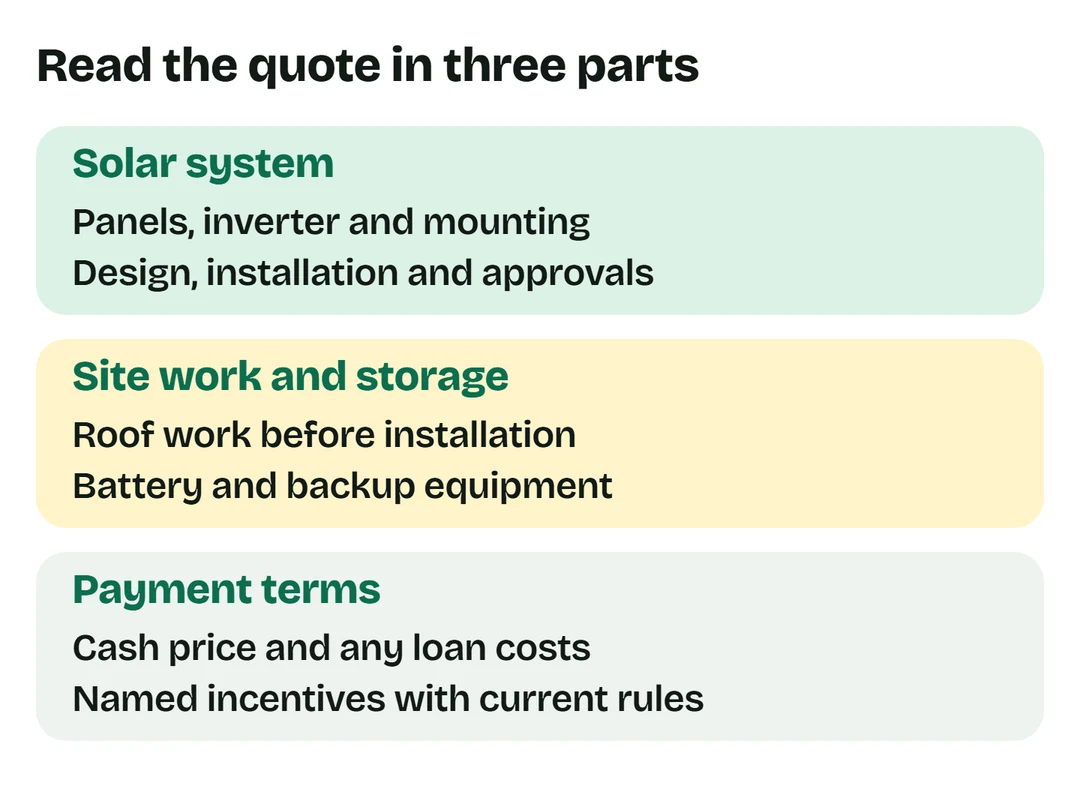
The panels are one part of a working system. Project Solar’s equipment description includes microinverters, racking, engineering plans, permits and installation support; its full-service option adds the installation work.
Ask whether the complete proposal covers design, mounting hardware, electrical work, permits, inspections, utility paperwork and getting permission to operate. A delivery of panels is a different purchase.
Put any roof work or battery on its own line. That makes it easier to compare two solar offers with different extra work.
Agree who pays if an inspection requires a change. It also helps to know which milestone triggers the final payment and who handles utility approval after the crew finishes.
What Owners Paid and Were Quoted
These US posts describe specific projects from 2024 and 2025. The capacities and battery details stay with the prices so you can see what each homeowner was buying.
- A Bay Area Reefers member shared a Tesla quote on June 24, 2025: $13,500 for 5 kW without a battery. I use the quoted amount before the poster’s historical tax-credit estimate.
- A Massachusetts homeowner posted a $38,250 proposal for 12.75 kW on August 12, 2024, with Q.TRON panels and Enphase microinverters. The post does not specify the incentive basis.
- A Chicago-area owner wrote on April 28, 2025, that a roughly 19.8 kW system with one Powerwall Plus had cost around $40,000 cash before the tax credit.
The Chicago owner also described prolonged lost production and service delays. I would ask an installer who handles repairs locally and what its workmanship and equipment warranties actually cover.
Your Roof Can Change the Budget
Have the roof assessed before committing to panels. If replacement is approaching, compare doing it first with paying later to remove and reinstall the array. My new roof cost guide covers that separate job.
One East Coast owner received a $10,190 removal-and-reinstallation quote for a 5 kW array on January 28, 2020. It was an older leased system, not a new installation bill.
Keep the removal price and roof warranty terms in the contract.
A Battery and Backup Power Are Separate Choices
If the goal is lower electricity bills, get a solar-only price and a separate storage price. If the goal is keeping appliances running during an outage, describe those appliances and how long you need them powered.
The Department of Energy explains that solar systems generally switch off when grid power fails. Backup operation needs suitable equipment, including a properly configured inverter and storage.
Do not assume a battery listed on a quote means every circuit in the house will work in a blackout. Have the proposal identify the backed-up loads, usable storage and any limits on simultaneous appliance use.
If you are comparing storage with a fuel-powered alternative, my Generac generator guide covers installed standby equipment. Ask each seller to quote the same backup needs.
Compare Cash, Loans and Leases Carefully
Get the cash price alongside any financed offer. Compare the amount financed, interest rate, fees, payment schedule and total payments, rather than choosing only by the first monthly payment.
A lease or power purchase agreement has a different ownership arrangement. The California Public Utilities Commission’s consumer guide explains that these customers still pay the solar provider as well as the utility.
Ask about annual payment increases, maintenance, selling the home and early buyout terms. The provider’s possible business tax treatment is not a homeowner tax credit you can automatically deduct from the contract.
Use your electricity consumption over the year to size the system. The proposal should show expected annual production, roof shading assumptions and the utility’s export-payment rules.
Solar capacity in kW measures system size; annual kWh measures electricity produced. A large system does not promise a zero bill. Fixed charges, when you use power and export credits all affect the result.
Questions About Installing Solar Panels
How much does a 6 kW solar installation cost?
At Project Solar’s advertised about $2.45 per watt, 6,000 W x $2.45 = about $14,700 before incentives and without a battery. Ask for a current quote for your home.
Can I claim the 30% federal solar credit for a new 2026 installation?
The IRS states that the Residential Clean Energy Credit is unavailable for property placed in service after December 31, 2025. Do not use the former homeowner credit to reduce a new 2026 installation budget.
Does a solar quote include batteries?
Confirm it explicitly. Compare solar-only equipment and installation separately from storage, backup controls and the circuits you want powered in an outage.
Will solar panels eliminate my electric bill?
Not necessarily. The CPUC explains that solar reduces rather than eliminates the utility bill. Savings depend on production, your usage pattern, the local tariff and any remaining fixed charges.
Where These Prices Come From
- Project Solar, Media Resource Page, its advertised installed rate and equipment/service descriptions, checked October 23, 2026.
- IRS, Residential Clean Energy Credit, cutoff for new installations, checked October 23, 2026.
- Department of Energy, Solar and Resilience Basics, checked October 23, 2026.
- California Public Utilities Commission, Solar Consumer Protection Guide, checked October 23, 2026.
- Bay Area Reefers, Sunrun/PGE Solar Panels, June 24, 2025; Solar Panels Forum, Massachusetts solar quotes, August 12, 2024.
- Tesla Motors Club, Chicago installation experience, April 28, 2025, and Panel removal for a new roof, January 28, 2020.
I hope this helps you read a solar proposal with more confidence about the amount you will pay. If a quote is hard to untangle, email me at costcheckr@gmail.com.