
Your check engine light shows P0101, or the engine hesitates, stalls at stops or runs rough. Before you pay for a new mass air flow sensor, here is what the job costs and when a cheaper fix is the real answer.
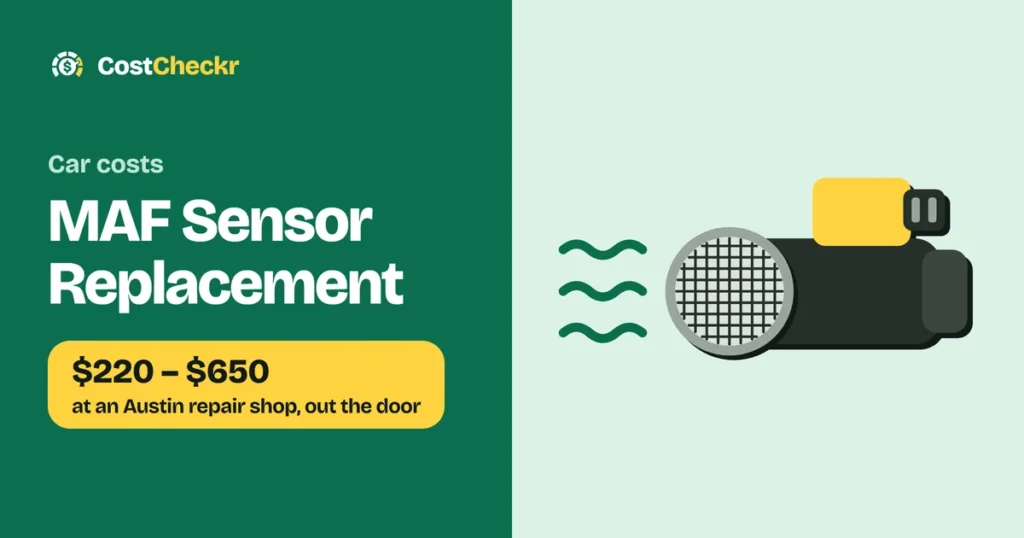
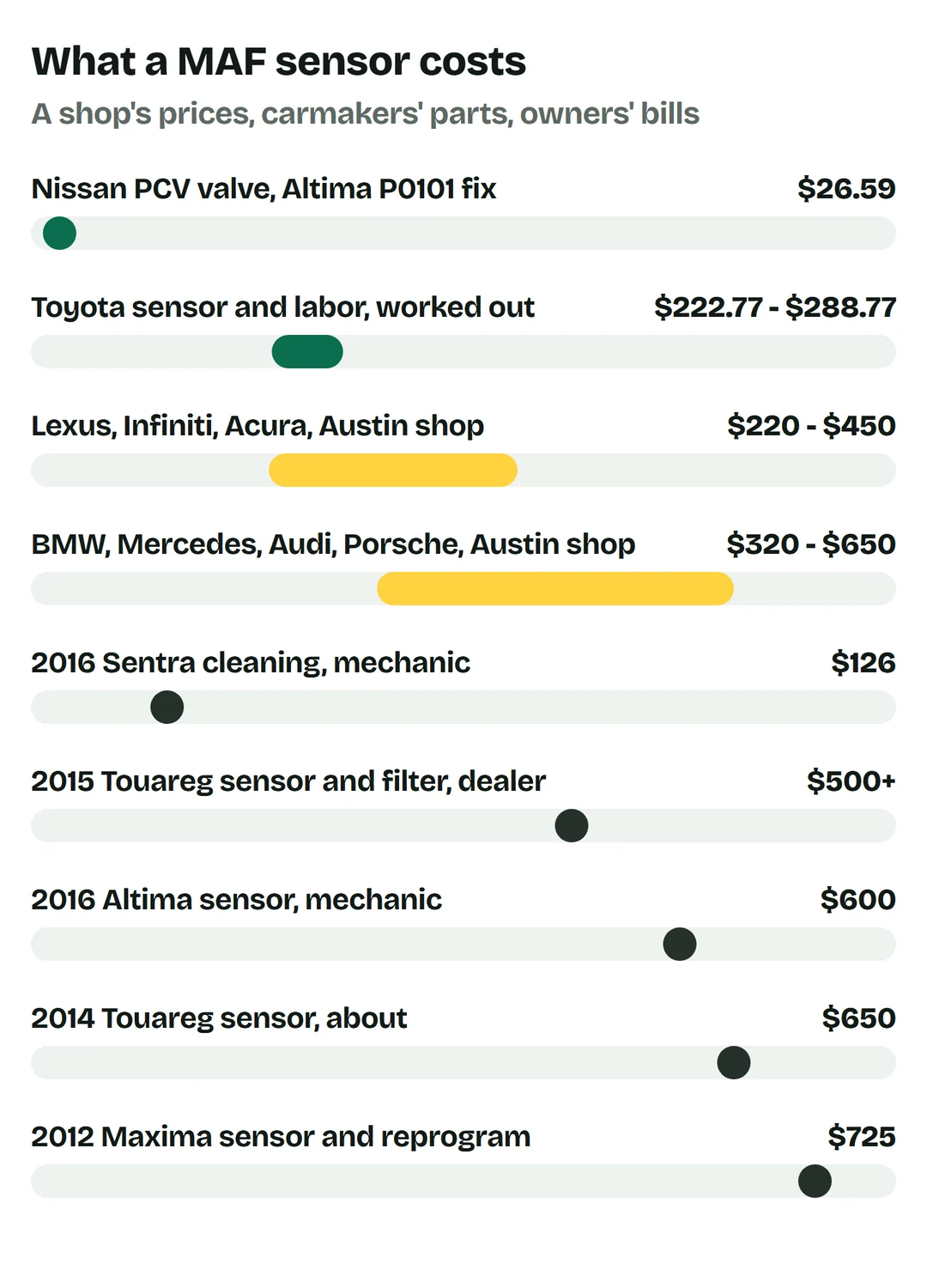
So how much does it cost to replace a MAF sensor? At Luxury Auto Works, a repair shop in Austin, the job typically comes to $220 to $450 on many Lexus, Infiniti and Acura models, and $320 to $650 on BMW, Mercedes, Audi and Porsche.
With Toyota’s own sensor for the Corolla, Camry and Avalon and the shop’s labor time, it comes to $222.77 to $288.77. Owners told NHTSA, the US road safety agency, they paid $500 to $725 at dealers and shops.
In this guide I will show you what the shop charges, what Toyota’s sensor and the job come to, and what owners paid. I will also show you when cleaning, a PCV valve or a software update fixes the code instead.
What a Repair Shop Charges
Here are Luxury Auto Works’ typical out the door totals, with the check, the new sensor, the intake inspection and the relearn, from August 2026:
The sensor itself is typically $180 to $450 new from the carmaker on most European and Japanese luxury models, and often $140 to $350 from the company that makes it for them, such as Bosch, Denso or Hitachi.
Budget aftermarket sensors are $60 to $150, but the shop finds failures and calibration errors common with them. Most MAF replacements book at 0.5 to 1.0 hour of labor there.
What Toyota’s Sensor and the Job Come To
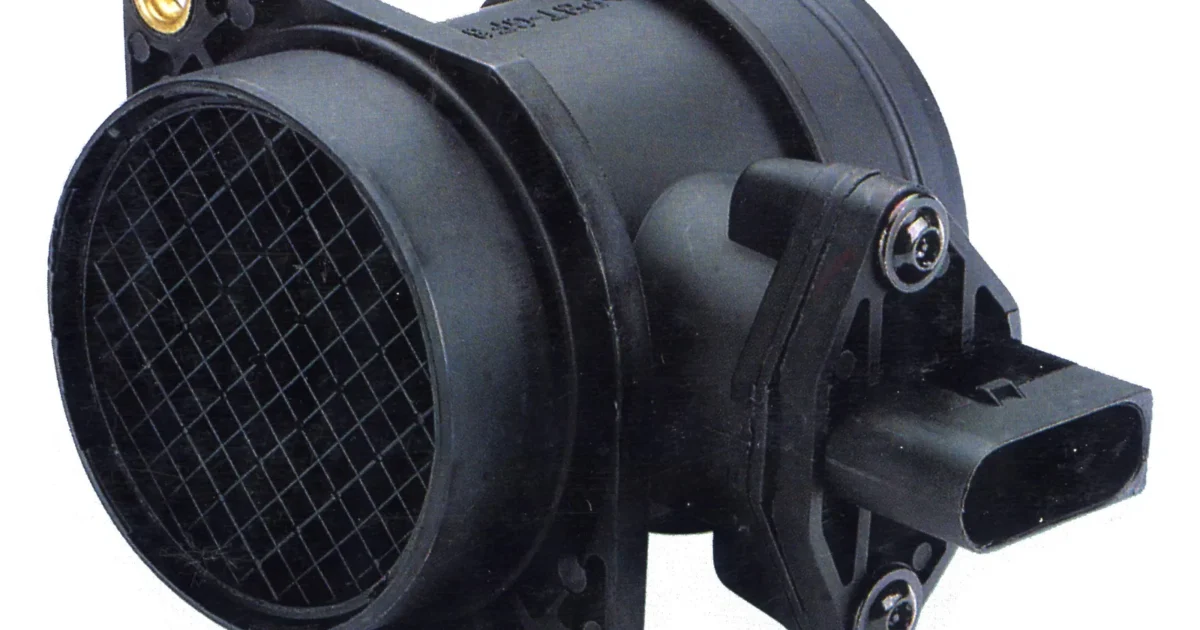
Toyota’s mass air flow sensor 22204-0V020 fits the 2009 to 2019 Corolla, the 2012 to 2017 Camry and the 2013 to 2018 Avalon, among others.
With its price on a dealer parts website, checked October 13, 2026, the Austin shop’s 0.5 to 1.0 hour, and $132 an hour, Tekmetric’s US average from June 2026:
So a new MAF sensor on these Toyotas comes to $222.77 to $288.77, inside the shop’s range for Lexus models. The sensor is most of the bill, so the part you choose matters more than the labor.
GM’s own time is in the same range. Water may have got into the sensor’s plug during assembly on some 2023 and 2024 Tahoe, Suburban, Yukon and Escalade V8 models.
GM pays its dealers 1.0 hour to replace the sensor and its plug on them under the warranty.
What Owners Paid
Here is what owners told NHTSA they paid or were quoted, with a link to each complaint:
- A new sensor on a 2016 Nissan Altima cost $600 at a local mechanic, filed in June 2021.
- A dealer charged $500 or more for a new air filter and MAF sensor on a 2015 Volkswagen Touareg after water got into the filter, filed in July 2020.
- A new sensor on a 2014 Touareg cost about $650 after its air filter got wet, filed in June 2019.
- A new sensor and a computer reprogram on a 2012 Nissan Maxima cost $725, filed in April 2018.
So owners paid or were quoted $500 to $725, more than the Austin shop’s Lexus range. A 2016 Altima owner paid about $1,500 for oxygen sensors, brake switches and a MAF sensor, and the problem stayed, filed in February 2025.
When Cleaning or a Cheaper Fix Is Enough
Cleaning can help when dust or an oil film coats the sensor and its electronics are healthy, the Austin shop explains. Use only MAF safe cleaner, and never touch the sensing element.
Cleaning will not save a sensor whose hot film is etched or whose signal drops out when hot. A 2016 Nissan Sentra owner paid $126 for a cleaning, and the same code came back a year later, filed in August 2023.
Nissan has a cheaper fix for P0101 on the 2013 to 2016 Altima with the 2.5 liter engine. Its dealers check the PCV valve, replace it if it is orange, and reprogram the engine computer if its part number is on Nissan’s list.
If that bulletin applies, Nissan tells its technicians not to replace the mass air flow sensor. The new black PCV valve, 11810-6N202, is $26.59 on a dealer parts website.
An intake leak can also look like a bad sensor. If the fuel trims go back to normal after a leak found with a smoke test is fixed, the sensor was never the cause. An oiled aftermarket air filter can also coat the sensing wire.
Signs of a Bad MAF Sensor
The check engine light comes on, often with a MAF code from P0100 to P0104 or a lean code like P0171 or P0174. The engine may idle rough, hesitate or stall at stops, with flat spots around 2,000 to 3,000 RPM.
Poor fuel economy, a fuel smell, hard starts when the engine is hot, or a failed emissions test can point to the sensor too. Have the codes and live data checked before you pay for a new one.
MAF Sensor Questions You Might Have
How much does it cost to replace a MAF sensor?
At a repair shop in Austin, typically $220 to $450 on many Lexus, Infiniti and Acura models and $320 to $650 on BMW, Mercedes, Audi and Porsche. With Toyota’s own sensor and 0.5 to 1.0 hour, it comes to $222.77 to $288.77.
How much is a mass air flow sensor?
Toyota’s sensor for the Corolla, Camry and Avalon is $156.77 on a dealer parts website. An Austin shop sees $180 to $450 for a new carmaker sensor on luxury models and $140 to $350 from Bosch, Denso or Hitachi.
Can I clean a MAF sensor instead of replacing it?
Yes, when dust or oil film is the problem and the electronics are healthy. Use only MAF safe cleaner and do not touch the sensing element. A sensor with an etched film or a signal that drops out needs replacing.
How long does it take to replace a MAF sensor?
Most replacements book at 0.5 to 1.0 hour at an Austin shop. GM pays its dealers 1.0 hour to replace the sensor and its plug on some 2023 and 2024 V8 SUVs.
Does P0101 always mean a bad MAF sensor?
No. Nissan fixes P0101 on some 2013 to 2016 Altima models with a new PCV valve or a software update, and an intake leak can look like a bad sensor too.
Where These Prices Come From
- Luxury Auto Works, Mass Airflow Sensor Replacement, Austin, Texas, August 28, 2026.
- Nissan bulletin NTB16-030a (December 2016) and GM bulletin 24-NA-158 (September 2024), on NHTSA’s website.
- Part prices, checked October 13, 2026: ToyotaPartsDeal 22204-0V020 and NissanPartsDeal 11810-6N202.
- Tekmetric, Average Auto Repair Labor Rates by State, June 30, 2026, and the owner complaints to NHTSA linked above, read October 13, 2026.
I hope this helps you fix the code for the right price, and only buy a sensor when the sensor is the problem. If you have any questions, you can email me at costcheckr@gmail.com.

.jpg)
