

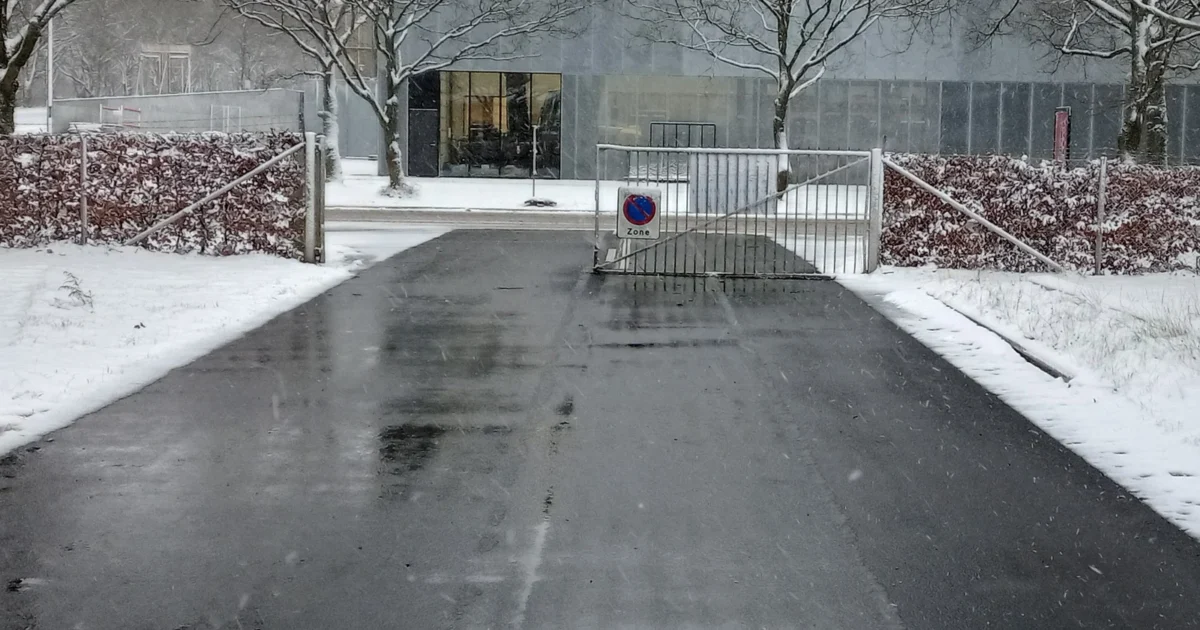
You are tired of clearing the same icy driveway after each storm, and heating it sounds appealing. Before asking for a total, decide how much pavement you want heated and whether the driveway itself needs rebuilding.
So WarmlyYours publishes heating-material prices of about $10 to $25 per heated square foot across its cable and mat options. That buys the heating product, before fitting, controls, electrical work and paving.
I will show you those product ranges, a running-cost example and three dated owner accounts. The aim is to understand the complete project without mistaking a cable price for a finished driveway.
Heating Materials Are One Part of the Budget
WarmlyYours’ US driveway page separates its products in a material-cost table, checked October 26, 2026:
For 400 heated square feet, the OmniMat range gives 400 x $12 = $4,800 and 400 x $20 = $8,000 in heating materials. Those are my sums from the manufacturer’s range, before the other work.
Have the contractor identify the chosen product and controls, the installation labor and the electrical connection. If an offer already includes a controller, do not add that component twice.
The paving needs its own scope. Our driveway replacement guide covers removal, the base and new pavement; those prices are separate from the heating products here.
Full Coverage or Tire Tracks?
You do not always need to heat the whole driveway. WarmlyYours offers full coverage and tire-track layouts, which heat the paths where the tires travel.
Its 20 x 20-foot comparison uses 400 square feet for full coverage and 160 heated square feet for tracks. The track figure belongs to that example, rather than a fixed allowance for every two-car driveway.
A track layout leaves other pavement unheated. Tell the designer how vehicles turn, where people walk and which areas must stay usable so the cheaper coverage still serves your needs.
For an irregular drive, use a measured sketch. WarmlyYours offers a custom installation plan covering the layout and electrical requirements.
What It Costs to Run
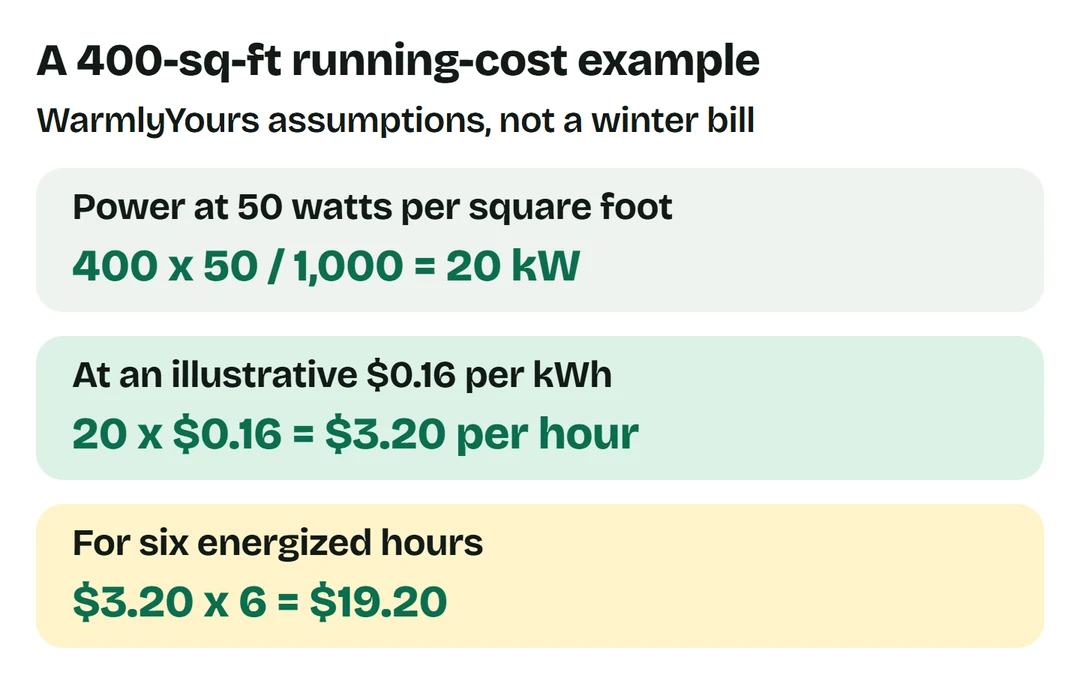
The useful calculation starts with heated area and power, rather than a promise about your whole winter bill. WarmlyYours’ driveway example assumes 50 watts per heated square foot.
For a 400-square-foot heated area, 400 x 50 / 1,000 = 20 kilowatts. At the manufacturer’s illustrative $0.16 per kilowatt-hour, 20 x $0.16 = $3.20 per energized hour.
For six energized hours, $3.20 x 6 = $19.20. The same WarmlyYours comparison gives $7.68 for six energized hours with its 160-square-foot tire-track example at that rate.
Use the energy rate on your own electricity bill. The maker includes preheating and drying in actual runtime, so six hours of snowfall need not mean six hours of power use.
The control strategy matters too. Ask how the proposed sensors start and stop the system, and whether the design heats separate areas together or independently.
Owner Accounts: Parts, Combined Work and Running Costs
These older reports describe different costs. I have kept the parts-only amount, combined project and reported energy increase separate rather than turning them into one installation range.
- On January 21, 2011, Garage Journal member thammel recalled parts alone in the $8,000 range for a DIY system installed about ten years earlier. The account also describes adding electrical service.
- On February 23, 2016, Albert C.’s BuildZoom review described a $20,000 project for a heated driveway and standby generator together at a new home in Washington Township, New Jersey.
- On February 9, 2022, Chicago member GrayFlattop described a friend’s gas bill rising by almost $500 in one winter month, four or five years earlier. The post describes a boiler system.
The last account is a friend’s experience relayed by a forum member, rather than a posted utility bill. The generator in the New Jersey job cannot be separated from its reported total.
Electric Cable or Hydronic Tubing?
The product ranges above are for electric heating. A hydronic design circulates heated fluid through tubing beneath the pavement, using a boiler or other suitable heat source and a pump.
WarmlyYours’ comparison describes water and propylene glycol in PEX tubing, with boiler service and fluid checks among the maintenance needs. Its electric system does not need that boiler assembly.
Ask for the full hydronic equipment and installation proposal if that is the design offered. The electric cable and mat ranges cannot price the boiler, tubing and mechanical work.
For electric heating, have the installer check the available electrical service before the paving date. The power calculation above helps explain why the connection deserves attention in the quote.
Plan the Surface and Drainage Together
WarmlyYours offers products for asphalt, concrete and pavers. Its asphalt guidance calls for cable designed to tolerate the paving temperature; its paver guidance places the heating in the bedding below the units.

Have the heating designer and paving contractor agree on the product, layout and installation sequence. Ask who tests the system before it is covered and again when the surface is finished.
Also settle where meltwater goes. The route off the heated area matters as much as removing snow from it, particularly where the driveway meets a walkway or the garage.
If new pavers are part of the project, our paver installation guide covers the base and access work. Its patio examples do not specify a heated driveway assembly.
Heated Driveway Questions
Is the $10 to $25 range a complete driveway price?
No. It combines the low and high endpoints in WarmlyYours’ heating-material table. Controls, fitting, electrical work and the driveway surface still need a complete proposal.
How much power does the 400-square-foot example use?
At the example’s 50 watts per square foot, 400 x 50 / 1,000 = 20 kilowatts. At $0.16 per kilowatt-hour, that is $3.20 for each hour the heating is energized.
Can heating go beneath pavers?
WarmlyYours describes compatible cables or mats in the bedding layer below pavers. Have the designer specify the assembly for your surface and vehicle loads.
Is electric or hydronic always cheaper?
Compare complete designs and your local energy prices. A hydronic proposal includes a heat source, pump and tubing, while the electric material rates here cover cables or mats.
Where These Prices Come From
- WarmlyYours, US heated driveway product ranges, controls and energy examples, checked October 26, 2026.
- WarmlyYours, electric and hydronic snow melting comparison, checked October 26, 2026.
- Garage Journal: thammel, January 21, 2011, and GrayFlattop, February 9, 2022.
- BuildZoom, Albert C.’s Albright Electric review, February 23, 2016, checked October 26, 2026.
I hope this helps you judge the complete project before the driveway is dug up. You can send a US heating quote or a question about its scope to costcheckr@gmail.com.